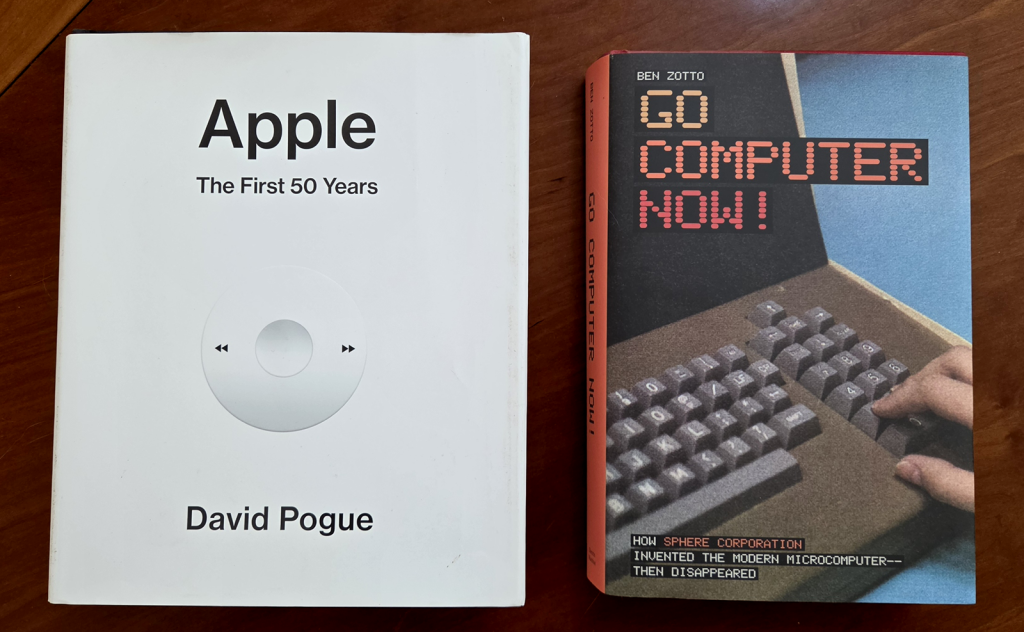
I’m reviewing two books here with their origins in the mid-1970s microcomputer revolution:
- David Pogue‘s Apple – The First 50 Years
- Ben Zotto‘s Go Computer Now – How Sphere Invented the Modern Microcomputer – Then Disappeared
These two companies – Apple and Sphere – started at around the same time with similar products. Yet the two corporate histories are quite a contrast. Apple is a wild success, becoming one of the largest companies on the planet. Sphere vanished with barely a trace, just a couple years after its founding. Yet, these two stories originating from the dawn of the microprocessor have remarkable connections.
Apple
Let’s start with Pogue’s Apple. These days David Pogue is a general science and tech journalist, covering a variety of topics on CBS Sunday Morning. I read his previous book How to Prepare for Climate Change: A Practical Guide. He recommended the Pacific Northwest as a US location likely to do well in our climate apocalypse future. But the summer I read the book, temperatures in Oregon went well into triple digits, and the Pacific northwest experienced the usual set of climate disasters (draught, fires, etc.). OK, maybe Pogue’s not your guy for climate-based relocation advice.
But when it comes to covering Apple, I can’t think of a journalist better situated for this subject. He’s been writing about Apple professionally for around 40 of it’s 50 years, at publications ranging from Mac World to the New York Times. He knows the products and the company intimately, and the people behind them on a first-name basis. It shows.
Pogue follows Apple’s timeline in a linear fashion, starting with the milieux Steves Jobs & Wozniak grew up with in Silicon Valley, delving into how Wozniak’s fascination with technology lead him to create his own computers from scratch. Jobs spots the business opportunity, and gambles on selling enough of Woz’s Apple Is before the bill for the parts comes due. The gamble pays off. From there, Pogue follows the creation of the Apple II and the formation of the company producing them.
The book is divided into four sections, based on the company’s leadership changes. The first is the early Jobs I era, covering the Apple I & II, the Apple ///, the Lisa and the early days of the Mac. A couple years into the Mac era, Jobs is forced out of the company, while John Sculley is the CEO. Sculley’s initial success fades as competition from cheap PC clones eats at Apple’s market share. The CEO role turns over multiple times, and by the mid 1990s, Apple is in dire straights. The third section details the “Second Coming of Steve”. Brought in to rescue Apple’s failing attempts to update Mac OS, Jobs dramatically trims Apple’s product lines, focuses Apple’s marketing, and lands hit products like the iMac and the iPod. The final section takes place after Job’s passing in 2011, covering the company’s dramatic expansion under the very different leadership style of CEO Tim Cook.
Pogue does a great job of dispelling many myths and misunderstandings about Apple. For example, it’s easy to assume that as a co-founder, Jobs was the original CEO of Apple, but that wasn’t the case in its early years. The venture capitalists funding Apple insisted on bringing in more experienced management. Pogue untangles the story of how Steve Job’s famous visit to Xerox PARC’s lab came about and the real impact it had. The book is filled with hundreds of color photos, and many sidebars and capsule biographies of key players. This format works great, allowing Pogue to clearly tell the main thread of Apple’s story while bringing along dozens of the quirky anecdotes the company is famous for. The result is a big expensive book, but the meticulous presentation is worth it.
Now, I personally have a good background on Apple’s story. I followed their rise in the pages of Byte magazine as a teenager, developed software for the Mac as soon as it was introduced, worked at Apple as an engineer for a few years as my first job after grad school. I’ve been developing Mac software for most of my professional career. I’ve read a few books on the company, and with most of them start rolling my eyes as I see writers tell stories that I personally know are off or outright wrong. That’s not the case with Pogue’s Apple. He talked to the people who were there, read the archives, tracked down the photographs and really got the story right. Not only is it fun to read now, but this will stand up in the future as the definitive history of Apple’s first five decades.
[I have just one nit with the book I do want to note: In a couple of places Pogue resorts to using AI slop images – for example, Steve Jobs dressed up for a marketing stunt that never happened. Pogue calls these out in the text, but fake AI imagery has no place in a work of history and journalism].
Sphere
In contrast to Apple’s wild success, the Sphere corporation is at most a footnote in the story of the microcomputer revolution. Author Ben Zotto remarks that it took him longer to research and write a book about Sphere than the company lasted as a business. The book’s title, Go Computer Now, is taken from a headline in one of Sphere’s early advertisements.
The Sphere computer was the brainchild of Mike Wise, a young computer programmer working at Brigham Young University in Provo, Utah. As soon as he saw the press covering Intel’s introduction of the 4004 microprocessor in 1971, Wise immediately recognized the chip’s potential for making computers vastly less expensive and more accessible.
Wise wasn’t an electrical engineer, but by 1975 he was able to enlist others to buy into his vision and help design a working personal computer. He launched Sphere from the living room of his small rental house in Bountiful, Utah, a suburb of Salt Lake City.
Wise had two key innovations in the original Sphere computer design: The first was to have the computer boot up directly using built-in ROM software, instead of toggling in programs using a primitive control panel with lights and switches. The second key idea was an integrated video display, eliminating the need to connect the computer to an expensive terminal or teletype.
In classic “fake it ’til you make it” fashion, Sphere started advertising their system in publications like Byte, before they even had a completely working prototype. They used the cash from orders to acquire parts and fund the company. The systems were originally sold as kits that had to be soldered together, a common practice in the early days of microcomputers. The ROM software for their first product was assembled by hand on pencil and paper, because the young company literally did not have access to a real computer yet.
Along with the innovations, the Sphere computer also had some serious design flaws. The power distribution for the system’s components was not well designed, and the rickety ribbon cables connecting the system’s printed circuit boards both contributed reliability problems that were never fully resolved.
Sphere eventually did start shipping kits to customers after months of delays. Kit builders often had to surmount numerous problems to get their system working. The software available was extremely primitive, and early on there wasn’t even a way to save or reload programs – they had to be typed in again from scratch every time the computer was turned on. Still, there was early enthusiasm for the products.
Wise, the founder, immediately saw opportunities for follow-on products, even while the company was struggling to get its initial computers into customer’s hands. Sphere was invited to submit a proposal Radio Shack, hoping to sell their design for the huge retailer to mass produce – only to never hear from them again. As financial problems at the company grew worse (somewhat due to Wise’s lack of business acumen) he was eventually, like Steve Jobs, forced out of the company. The company was never able to generate enough cash from sales to fully fund producing their existing products, let alone designing new ones.
Zotto does a fantastic job of making Sphere’s obscure story an entertaining read. Like Pogue’s Apple, the book is carefully researched, and full of photographs of Sphere’s people and products. Unlike Apple, Zotto covers much more detail of the early 1970s technology landscape that led to microprocessors and the eventual ubiquitous personal computer.
Sphere and Apple
It’s interesting to compare the trajectories of Sphere and Apple. A key difference was starting in Silicon Valley, Apple had access to venture capital to fully fund their company’s expansion and development of their hugely successful Apple II. Moreover, the same VC’s that provided cash found experienced management for Apple, skills the young founders at both Sphere and Apple did not have to start with.
Sphere and Apple’s paths crossed directly in another significant way. In the mid-1970s, a common marketing tool for early microcomputer companies was the road show – literally loading an RV up with your prototype, and driving to various locations across the country to give customers a chance to see the product live. Sphere did this, and one of their early important stops was the Homebrew Computer Club in Palo Alto California, where a young Steve Wozniak witnessed the Sphere demonstration.
The Sphere and the Apple I share key innovations – built-in ROM software and video display. Was the Sphere an inspiration for the Apple I? Wozniak claimed he had the 6502-based Apple I prototype construction well underway when he saw the Sphere demonstration, but in an end note, Zotto says:
“Wozniak’s timeline appears to be misremembered in [his autobiography] iWoz. He states the Wescon ’75 show occurred in June, which leads him to conclude his Apple-1 prototype was completed at the end of that month. In fact, Wescon was in September, and the early batch of MOS Technology 6502 chips were sold at that time. Thus Wozniak’s prototype could not have been completed until sometime after seeing the Sphere demonstration at Homebrew during the week of the Wescon show.”
Zotto goes on to note that Wozniak declined to be interviewed for Go Computer Now. Even the 6502 availability, however, is not definitive. One of the quirks of the original Apple I is it supports both the MOS 6502 and Motorola’s 6800, so it is theoretically possible Wozniak could have started with a 6800 instead. This all happened over a half-century ago, so by now an exact reconstruction of events may not be possible.